Tuesday, 23 July 2019

My Life as a Tapestry - 11 (Comings out and their outcomes)

At the beginning of this 3-year period (mid 1979 to early 1982) I had left the theatre group (Sidewalk), split up with Berta (my partner of 5 years), and was looking for a way out of the communal house.
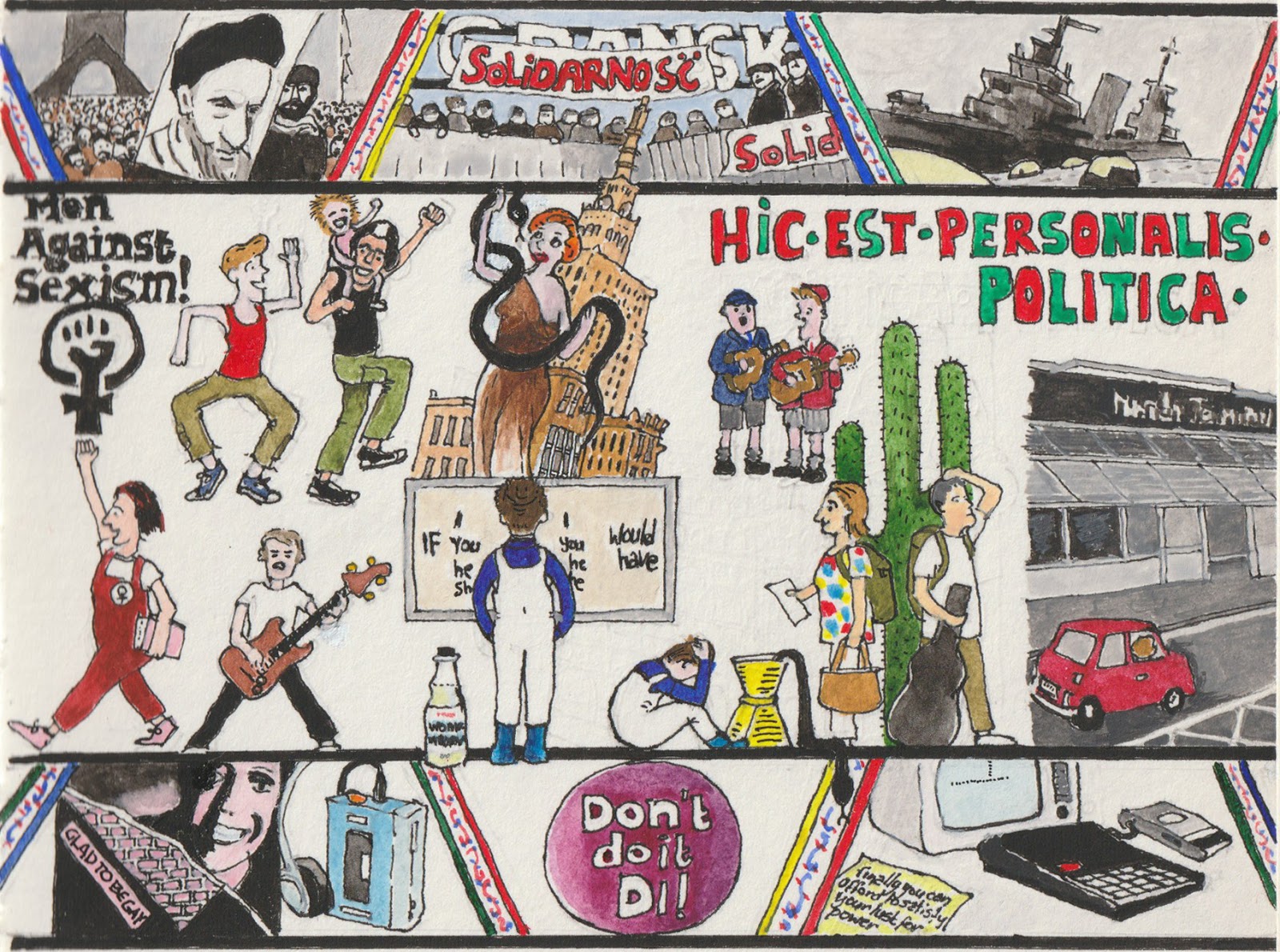

Berta and I parted relatively amicably -  she wanted to come out and live her politics and went to join a radical feminist collective and be a writer. (Much later I was thrilled to discover that she became well-known internationally, as a Jewish Lesbian poet).

1979 was a time of coming out generally, following the new sexual politics of the women’s movement. The pretend-Latin caption here is the slogan of the time: ‘the personal is political’. Tom Robinson’s anthem ‘Glad to be Gay’ had come out the previous year and got to number 18 in the singles charts. Well-off people listened to it on their new Sony Walkmans.

More globally, Iran came out as an Islamic republic with a fundamentalist cleric as supreme leader; nuclear power came out as Armageddon in waiting at 3-Mile Island in the US. Sid Vicious and Lord Mountbatten came out dead.

Peter and I joined a local men’s consciousness-raising group. This was started by Colin and Mac, who were living round the corner in a 4th floor flat. They were both tall, good-looking, charismatic, and politically right-on (if somewhat anarchistic). With some other local guys we sat in a circle and earnestly confessed what was wrong with our attitude to women. Then we confessed what was wrong with our attitude to men. Once we all held hands. On another occasion we were going to do some group yoga, but one of the other guys wanted to do it unclothed in order to get in touch with our real selves, and the session never quite got off the ground. The high point was when we all went to the first ‘Men Against Sexism’ national conference in Manchester. Mac took his 3-year-old daughter and my abiding memory is of him and Colin cavorting in the crowd at the conference disco with the little girl whirling around above us on her Daddy’s shoulders, shrieking delightedly.

After leaving the theatre group I didn’t have any paid work for a while, and I think I got by on supplementary benefit. If you had an Equity (actors’ union) card, which I did, you didn’t have to make yourself available for work other than acting, and there wasn’t much of that. I passed some of the time playing bass for a post-punk band called ‘The Wimps’, whose singer was also in the men’s group.

Then Tony got me a job teaching with him on a summer school in Poland. There I met L. and my life changed. This image of her is dredged right out of my subconscious – it is based on a ‘snake’ Tarot card I once saw. The snake in Tarot is a complex symbol that stands for rebirth and forbidden knowledge as well as desire, seduction, craving, etc. All of which came to pass, and of course, the snake can also do for you! Behind her rears the Palace of Culture in Warsaw, needing no further explanation I hope. Poland at the time was in the grip of an unprecedented challenge to the authority of the Communist party from the Gdansk shipworkers and the Solidarity trade union movement. Tanks were involved. It felt exciting and dangerous. As did L., for me. Catalyzed by Wiborova vodka, we began an intense, doomed (because she was married with a family) affair. I cut my hair so that it stuck up like Sid Vicious. I dyed my old Spanish leather boots bright blue and wore them with white dungarees. She introduced me to TEFL (Teaching English as a Foreign Language) which I took to like a duck to water, mastering the modal conditional at a glance! I did a short training course, became a freelancer like her, and started to make a bit of money doing teacher training jobs with her. I moved out of the communal house and into Colin’s housing association flat with him and we put together an alternative cabaret act, where we wore school uniforms and sang Everly Brothers songs. To be fair, it wasn’t just me that was drunk on glamour – the whole country seemed to be in the thrall of the Royal Wedding (how prescient that ‘Don’t do it Di!’ badge now seems to have been).

The wheels came off the affair during a teaching job with L. in Kuwait in Autumn 1981. The snake escaped its cup (another Tarot card, standing for the perils of illusion and allure) and I was no longer smitten, but bitten. Enough said.

My bubble had collapsed, and my self-respect with it. But Myrtle came to the rescue, bless her. An occasional boyfriend of hers had gone to Mexico to study Spanish and she was proposing to go and visit him. Did I want to come? Yes I did. We flew to Houston, got a Greyhound bus to Neuvo Laredo and another bus from there to Mexico City. We had a few adventures there (Myrtle particularly, but my lips are sealed) and eventually took another bus to Xalapa where her friend was living. We found accommodation there and stayed nearly 2 months. I made some friends and some money teaching English and started to learn Spanish from children’s books. By the end of the time I had filled a notebook with poems and little stories (pastiches of Juan Rulfo who I also read) in my erratic Spanish. Myrtle went off travelling in the south but I decided to go home, as Colin had written to say he was moving out of the flat to live with a new girlfriend and we needed to go on paying the rent to make sure the Housing Association didn’t take it away. Some of my Mexican friends were convinced I was going back to England to join the army and go and fight the Argentines in the Malvinas (Falklands) but funnily enough it never crossed my mind. (I have just noticed that the final image of myself in front of the cactus is the same perplexed pose that I finished with in episode 7. Although staring at the future rather than at a toilet).

I had an eventful journey back – one coach caught fire, another left me in the service station at Saltillas and went off with my luggage, guitar, and a little bag with my book of poems and stories. When I finally caught up with it at Laredo I got the luggage and guitar back, but the little bag with the stories was lost for ever. I often wonder what the thief who took it made of my semi-literate ramblings.

The era ended with me getting the complete strip search treatment from a dim but enthusiastic customs officer at Gatwick airport who was convinced that the presence of dental floss and anti-diarrhoea pills in my toilet bag pointed with 66.666% certainty to me being a drug mule with a stomach full of cocaine wrapped up in condoms. He kept me for 3 hours until I finally agreed to have an X-ray to prove my innocence, at which point he let me go without giving me the X-ray. For some of that time my sister Gilli, who had come to meet me, was sitting outside in Mum’s mini. Before she gave up and went home.

Back in the UK, the country was enduring Thatchers’ war and her subsequent triumphalism. But there was a bright spot on the horizon – the Sinclair ZX81 came out and my destiny took a new path. 

Tuesday, 24 July 2018

My Life as a Tapestry - 10 (Living the Revolution)

This episode (1977-78) incorporates turning 30, alarming to contemplate even at this distance – 30 years old and still playing at adulthood. The picture is dominated by the house in Westbourne Park where I lived with a shifting population of co-communards and co-workers from a variety of socially-funded (ahem) creative and self-help enterprises, whose livelihood was made possible by cheap food, rent, utilities, transport, and what now seems like an unbelievably laid-back system of State unemployment benefits.

My general self-absorption during this time is reflected in this panel by the absence of any depictions of wider social and political issues (ie: no reference to the Red Army Faction, Grunwick, the Yorkshire Ripper, 3 Mile Island, the death of Elvis, the Sex Pistols, Jimmy Carter, the Silver Jubilee, the Iranian Revolution, Margaret Thatcher etc). Let’s say I was living my politics at this time – surrounded by the invisible but highly ideological graffiti artists of North Kensington.

I was also surrounded by the weird and wonderful denizens of No.8. I’ve shown Peter, sharing a joint with me on the roof by moonlight, and playing The Irish Washerwoman whilst rhythmically thumping a foot on the wooden floor of his top storey room (you could hear him in the basement). 

Berta, about to be buried under an avalanche of books that she had just brought from her flat in Ilford, to come and live with me (we had separate rooms). She put the shelves up herself, refusing my offers of help on grounds of gender autonomy (no comment).

David P. endlessly re-building or repairing something around the house (thank god someone was). 

Anita and Sue doing something possibly dope-related on the carpet in the living room.

The communal kitchen table, although I don’t think that particular group of people ever sat round it all at the same time: Dave H., still trying to make a living as an actor; his scary pal Des, and Jill the artist who shared a room with Des and drove him into homicidal rages; Mick, shortly before he cut off his afro and went off down the district line to live with his new girlfriend; Pamela, whose cat was periodically witch-hunted by Jill for bringing fleas into the house; Maggie, one of the original communards from when the house was first bought by a rich Marxist; and the sinister David R. who was forever lurking round corners and chuckling to himself and had a reputation as a local poet and eccentric. The windows are full of the silhouettes of the many others who passed through, the good, the bad, and the drug-addled.

And on the steps outside I’ve drawn Myrtle, holding hands with one of her small charges from the local nursery where she actually had a proper job. Myrtle was one of the few points of connection we had with the West Indian population of North Ken. Our local was the Apollo at the corner of All Saints Road and we spent a lot of time in there, although we rarely had much interaction with the black people who also frequented it. Everyone rubbed along fairly amicably in those days without exactly socialising together (it didn’t stay like that – see the account at the link above).


As well as signing on for Supplementary Benefit as an out-of-work actor, I was making pocket money from my fulltime occupation with Sidewalk Community Theatre. We worked hard and travelled a lot, first around North London and eventually the rest of the country and abroad to Holland. I still have clear memories and not a little fondness for the motley collection of vehicles that I borrowed, drove, mechanicked, and sometimes wrote off during this period.

Bob lent me his mini which I managed to get squashed under a lorry somewhere down the Caledonian road when I was late for a gig. (Despite my meagre income I did manage to pay him for it in instalments over the next 18 months).
Berta lent me her Honda Chaly bike on which I dodged other lorries along the Euston road on my way to rehearsals in Newington Green. Although it was tiny it had a 90cc engine which meant Peter was able to drive it on the M1, all the way to Hemel Hempstead in a thunderstorm with a 5-foot stainless steel microphone stand sticking up out of his rucksack.

Sidewalk had a series of old vans culminating in a 5-ton 1950s bread van which one of the group bought and had the windows customised to look like a clown face. It may have looked jolly but it was hellishly drafty inside and the heating kept breaking down. The whole thing eventually broke down in Aberdeen in January 1979. When we finally got it going again I and another group member drove it back  to London without stopping, for fear of not being able to start it again. You had to drive with one hand on the wheel whilst keeping the other hand inside the engine block in the cab - one finger over an outlet on the carburettor so that you could release air bubbles as they formed, which happened at 10 minute intervals.

Peter and I drove to North Wales in his ancient Reliant Robin. It too broke down, in fog, outside Reading police station. Luckily we managed to get it started again quite quickly, which was a bit of a relief, as we had a large bag of homegrown weed in the glove compartment.

Sidewalk started off doing plays for children and graduated to adult plays in 78-79. I’ve depicted some of the characters I played, and also shown myself when I wasn’t wearing a costume. It is not easy to tell the difference. I remember how much I hated ‘materialism’ in those days – typified for me by the fashion industry, shopping malls, advertising of all kinds. I got my clothes from jumble sales and I remember this particular outfit very well: green corduroy jeans (with a bit of a flare), a woman’s waisted grey silk jacket, a woolly hat, grey suede boots that were a size too big, and…. BLOODY LEG WARMERS! (Oh the shame).

My children’s characters included: Cecil the Mayor, whose first appearance in his big red cloak had 5-years screaming with fear and scrabbling over each other to get to their mothers. Berkeley the snotty school kid who won gold cups and whose scatological war with his underclass neighbours got us banned from some of the Islington Schools where we performed. Podgie the Cat, tormented by Berta with a cut-down Emu puppet.

The adult characters included a sinister Punch and Judy man, a patriarchal paterfamilias in a play about the Women’s Suffrage movement, and Dave the well-meaning male chauvinist  in ‘Son of a Gun’ (see the link to Sidewalk above), which was actually one of the first theatrical expressions of the burgeoning women’s movement in the UK in the 1970s. I’ve included a little visual tribute to Norma and Ken who starred in the first version of that play and who inspired me with performances of consummate comedy and bathos.

I look back on all this now as a kind of late late adolescence. A strange combination of community commitment and personal irresponsibility. My growing up would still be some time coming, but, flying in over Trellick tower in a NZ Airlines jet as 1977 came to an end, although unknown to me at the time, was its eventual cause.


Thursday, 25 January 2018

My life as a Tapestry – 9 (the underground years)


My late twenties (1973-76) passed in a haze of tobacco and dope smoke - daydreaming on platforms, buses and tube trains across London as I circulated between Newham, where I worked, and North Kensington, Oakwood, and Riddlesdown, where I partied. The bad Latin title is meant to say ‘Here one is transported, to work and in reverie’. At that time it seemed to me that absolutely nothing was happening in my life. In retrospect the period actually seems to have been quite active and creative, as the images in this panel (drawn far too small in order to get everything in) might suggest.


For a start, global events were fairly momentous. The Vietnam war ended in humiliation for the US and Richard Nixon got hounded out of office. The IRA was carrying out a bombing campaign in London  - over 40 explosions in one 14-month period. Considering how much time I was spending in stations I was probably quite lucky not to get caught up – the nearest I came was the Camden Hill Square bomb in 1975 which I heard go off, 3 miles away in Westbourne Park. In 1972 Idi Amin threw 40,000 of his citizens, who happened to be of South Asian descent, out of Uganda and in 1973 27000 of them who also had British passports came to live in the UK, fueling Enoch Powell’s self-serving paranoia and the rhetoric of right-wing press.


My friend Dave who was doing a drama course at Trent Park invited me to be in his production of Peter Shaffer’s one-act play ‘The Private Ear’. I played Bob, with a Buxton accent I’d picked up from another Dave who I’d shared a room with at college. Dave and I would rehearse the play in the evening and then spend much of the night getting stoned and playing chess. Chess was a small metaphor for my life – it always started promisingly but ended with me losing my concentration and…well, losing. In the mornings I’d stagger onto the tube at 7am in order to be at Little Ilford School by 9 – ready to spend the day blagging my way, totally unprepared, through ‘drama’ lessons with crowds of feral 3rd and 4th years.

I lived in a series of bedsits and flats in east London, and during the week when I wasn’t at school I spent my time sitting around smoking and writing plays and recording songs, in between stuffing electricity meters with 50p pieces. For a while in 1974, due to an economic crisis, the government tried to persuade us not to use any electricity at all for half of the week. Mostly at weekends I took the tube to Westbourne Park and stayed at a communal house McGregor rd, where Peter lived, who played Irish jigs on the fiddle and introduced me to Marxism. We smoked and drank a lot and I spent quite a lot of time sitting in the toilet with the whirling pits - Peter knocked on the door from time to time to see if I was OK, and everyone else in the house had to use the upstairs loo.

When I didn’t go west I went south, via London Bridge, to sit at home and drink Dad’s whiskey and eat Mum’s shepherd pies. My sister Gillian was an aloof and guarded teenager by this time, no longer the child I used to tease and have rough-and-tumbles with.

After a year at Little Ilford I left and went to work with Tony at a much smaller school for boys, behind Newbury Park bus station (astonishingly now a grade 2 listed building). He ran a creative activities department in a separate annexe from the main school, where we put on a whole load of classes and workshops in music, art and drama, plays, events, happenings, and general creative mayhem that quite often involved cutting-edge technology such as reel-to-reel tape recorders. One event that captured the headteacher’s imagination was a reconstruction of the battle of Rorke’s Drift (as featured in the film ‘Zulu’) for which boys dressed up as Zulus and charged other boys dressed as British soldiers while Tony made rifle volley noises on a tambour. Our great achievement was to train them to do it in slow motion so that it wasn’t over in an instant and no blood was actually shed.

For a while I lived on the 7th floor of a tower block in Walthamstow, in the flat of a middle-aged woman who was a primary school teacher with a five-year-old son. She used to let some drug dealers she knew use her hallway as safe house for suitcases full of hashish recently smuggled in from Morocco. I think she was looking for a father for her son, but I disappointed her by bringing my girlfriend Jean home to stay. I eventually disappointed Jean too – she gazes sorrowfully out of the picture and I feel a twinge of shame.

Tony and I joined Teachers’ Rank and File (actually International Socialist Party entryists in the NUT) and went around being militant about wages, conditions, and the right-wing backlash to the progressive education movement.

Towards the end of 1974 I started going out with Berta, also a Newham drama teacher, who lived in a tiny one-room brocade cave on the first floor of a house in Ilford, with an outside toilet. Berta played me her Bill Evans records, and got me interested in modern jazz. This was to complicate my musical development for quite a few years to come.

My career as a teacher came to an end in the summer of 76 when I left my job at Tony’s school to go and join a political theatre group.